
For millions of persons with disabilities in low‑ and middle‑income countries (LMICs), access to rehabilitation services remains a distant hope. Specialist facilities are often concentrated in urban centres, leaving rural and conflict‑affected populations without essential care. Community‑Based Rehabilitation (CBR) emerged as a pragmatic and rights‑based strategy to bridge this gap, delivering services through local resources, community participation, and intersectoral collaboration. This article examines the core principles of CBR. It also synthesises the evidence for its effectiveness, identifies the ingredients of successful programmes, and confronts the persistent limitations that the field must overcome.
What is Community‑Based Rehabilitation?
CBR is a strategy for rehabilitation, equalisation of opportunities, poverty reduction, and social inclusion of persons with disabilities. Rather than relying on distant hospitals or specialist institutions, CBR is implemented through partnerships among persons with disabilities, their families, communities, non‑governmental organisations (NGOs), and government agencies. The Joint Position Paper on Community‑Based Rehabilitation, developed by the International Labour Organization (ILO) , UNESCO , and the World Health Organization (WHO) , articulates the vision of CBR as part of a broader community‑based development framework. The WHO CBR Guidelines (2010) provide CBR managers with practical suggestions on how to develop or strengthen programmes and ensure that people with disabilities and their families can access the benefits of the health, education, livelihood, and social sectors.
The CBR Matrix: Five Key Components
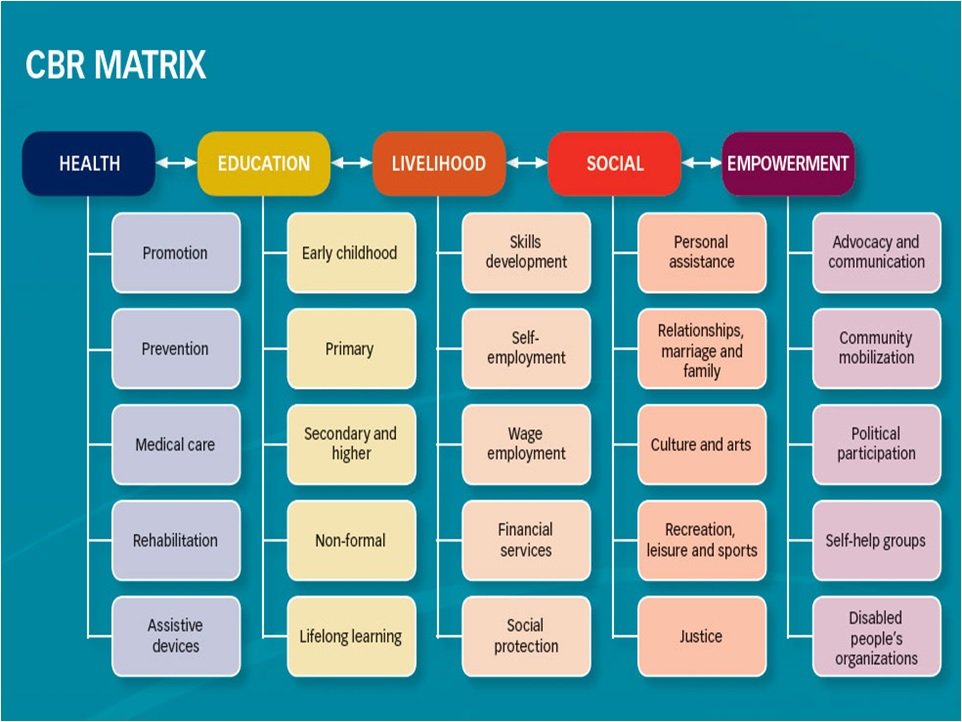
The guiding framework for modern CBR is the CBR Matrix , which organises activities into five interdependent components. The WHO CBR Matrix includes health, education, livelihood, social inclusion, and empowerment as its core pillars. Within each component, programmes address specific elements tailored to local needs and resources.
- Health encompasses early detection, access to medical care, rehabilitation services, and assistive devices.
- Education focuses on early childhood development, inclusive schooling, and lifelong learning.
- Livelihood includes skills development, employment opportunities, and poverty reduction initiatives.
- Social inclusion promotes family involvement, cultural participation, and accessible community spaces.
- Empowerment strengthens advocacy, communication, political participation, and self‑determination.
These components are not isolated. The empowerment pillar, for example, cuts across all others, ensuring that persons with disabilities are not passive recipients but active agents in their own development.
Evidence for Effectiveness
A robust and growing evidence base supports the effectiveness of CBR in LMICs, including African nations. A Campbell systematic review by Iemmi et al. (2015), which included 15 studies, concluded that moderate to high quality evidence shows that CBR has a positive impact on people with disabilities. Outcomes include improved physical functioning, increased participation in daily activities, and enhanced quality of life.
A scoping review of community‑based stroke rehabilitation in low‑resource settings found that most studies were randomised controlled trials conducted in middle‑income countries, with positive findings for functional recovery and community reintegration. More broadly, a systematic review on CBR for people with disabilities in LMICs suggests that CBR may be effective in improving clinical outcomes and enhancing functioning and quality of life.
In sub‑Saharan Africa, a scoping review of community health workers delivering physical rehabilitation services identified evidence from seven countries—Eritrea, Ethiopia, Malawi, Mauritius, Namibia, South Africa, and Uganda. Community health workers delivered assessments, case management, health education, community liaison, and health system linkage, demonstrating that task‑shifting can expand rehabilitation coverage. A pilot study in Ethiopia found that lay health workers, after training, improved their competence in delivering CBR for people with schizophrenia, with therapeutic alliance competencies showing the earliest gains.
Key Success Factors
Analysis of effective CBR programmes reveals a consistent set of ingredients. Successful programmes exhibit strong community ownership and participation, ensuring that interventions respond to locally identified needs. Training and supportive supervision of community rehabilitation workers (CRWs) is critical, as formal rehabilitation professionals are scarce in LMICs. Integration with primary healthcare and referral systems prevents CBR from operating in a silo, allowing persons with disabilities to access higher‑level care when needed. Partnerships with local NGOs and disabled persons’ organisations (DPOs) ensure that programmes are grounded in lived experience and advocacy. Finally, attention to livelihoods and educational access addresses the social determinants of disability, moving beyond a purely medical model.
Contextual adaptation is perhaps the most important success factor. Programmes that incorporate local cultural practices and leverage traditional social support networks are more likely to achieve acceptance and sustainability. A proof‑of‑concept study in southern Africa examined how countries in the region have adapted global CBR frameworks to local realities, revealing the importance of tailoring approaches to specific political, economic, and cultural contexts.
Limitations and Gaps
Despite its promise, CBR faces substantial challenges. Evaluating CBR is notoriously difficult due to heterogeneity of programmes, which vary widely in duration, intensity, target populations, and outcomes. There is a limited number of rigorous randomised controlled trials, in part because CBR is a complex social intervention that resists standardisation. Variable reporting of outcomes further complicates efforts to synthesise evidence across studies.
Resource constraints remain a persistent barrier. CBR programmes often operate on shoestring budgets, limiting their ability to scale or maintain services over time. A systematic review of CBR implementation challenges identified five main themes: lack of skilled workforce and training deficiencies, insufficient resources, poor integration and coordination, attitudinal and cultural barriers, and burden on caregivers. These findings underscore the need for stronger integration of CBR into national health and social policies. As the WHO’s Rehabilitation in Health Systems (2017) document emphasises, rehabilitation services should be integrated into health systems at primary, secondary, and tertiary levels—not treated as an optional add‑on.
Looking Forward: Inclusive Development and CBR
The vision of CBR has evolved from a narrow rehabilitation strategy to a vehicle for community‑based inclusive development (CBID) . This approach recognises that disability is not solely a health issue but a cross‑cutting development concern. CBID aligns with the United Nations Convention on the Rights of Persons with Disabilities (CRPD) , which mandates full participation and inclusion. The 2010 CBR Guidelines explicitly promote CBR as a strategy for community‑based development involving persons with disabilities. When CBR is embedded within national development plans and linked to broader poverty reduction strategies, its potential to transform lives multiplies.
Explore more insights on disability inclusion and community‑based strategies at Centre for Elites:
Community‑Based Approaches to Disability and Mental Health — a deeper examination of inclusive models in low‑resource settings.
For authoritative guidance, consult the World Health Organization’s CBR Guidelines, the International Disability and Development Consortium (IDDC), and the Campbell Collaboration systematic review on CBR effectiveness.
Explore Videos and Subscribe to our YouTube Channel: https://www.youtube.com/@AfricaPeaceInitiative
Hi, this is a comment.
I appreciate you peace initiative. We need more peace makers on this unstable World to make it much better. Keep up your best effort to sow peace!