
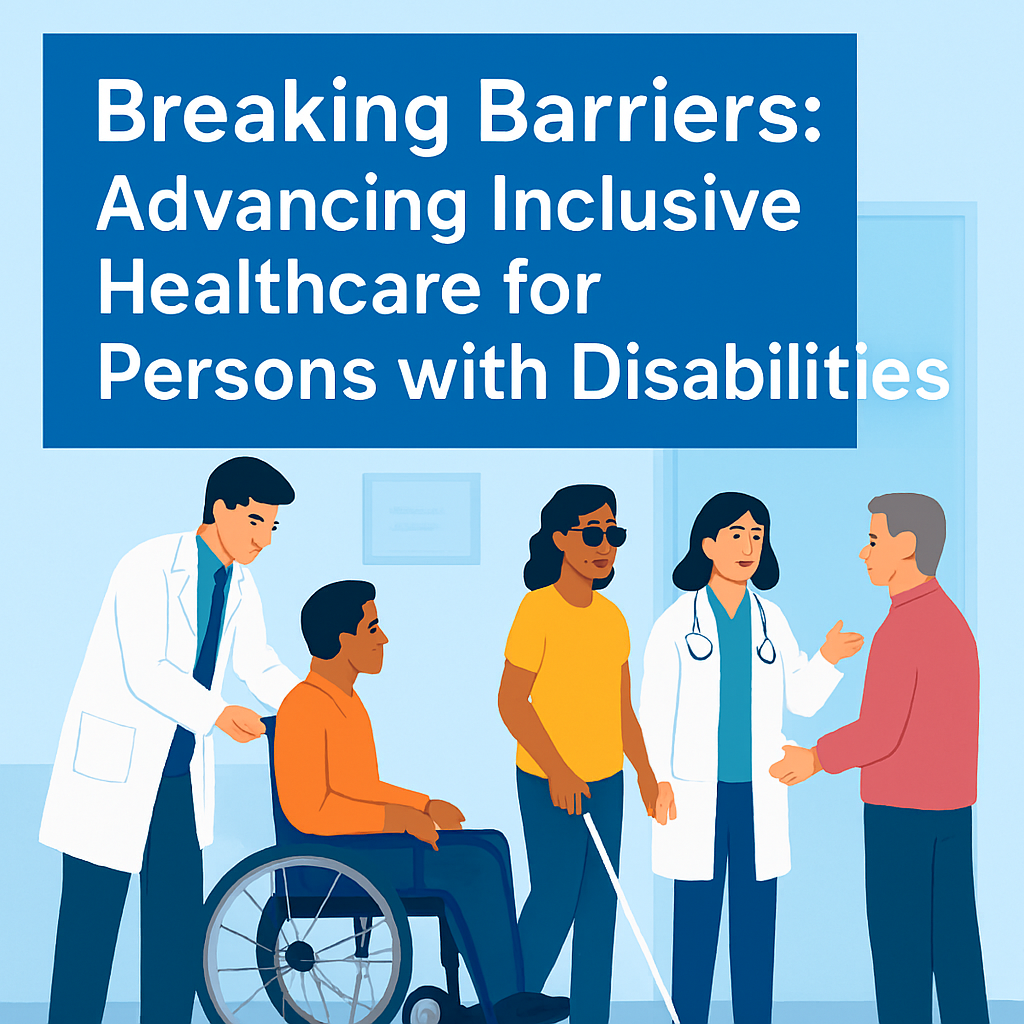
Healthcare is a fundamental human right, yet for the estimated 1.3 billion persons with disabilities globally, this right is often compromised by pervasive barriers (World Health Organization [WHO], 2022). Achieving true health equity requires moving beyond mere physical access to dismantle the systemic, attitudinal, and communication obstacles that prevent this population from receiving care that is effective, respectful, and equitable. Advancing inclusive healthcare necessitates a multi-faceted approach focused on identifying systemic gaps, implementing universal design, and advocating for robust, person-centred policies.
Equity in Access: Beyond the Ramp
Equity in healthcare for persons with disabilities means more than a wheelchair-accessible entrance; it demands that services be available, acceptable, and of equivalent quality to those available to others. However, significant barriers persist. Physical barriers include examination equipment that cannot accommodate individuals with mobility impairments, such as fixed-height examination tables (Merten et al., 2015). Communication barriers are equally debilitating, with a frequent lack of accessible formats like braille, easy-read documents, or qualified sign language interpreters, leading to critical gaps in informed consent and treatment understanding (DeCamp et al., 2018).
Perhaps the most insidious obstacles are attitudinal. Healthcare providers may hold implicit biases, including “diagnostic overshadowing,” where symptoms are incorrectly attributed to a patient’s existing disability rather than investigated as a new, acute condition (J. F. Woodward et al., 2020). These biases, coupled with a lack of disability competency in clinical training, can lead to disrespectful treatment, rushed consultations, and ultimately, poorer health outcomes. Equity, therefore, requires proactive removal of these barriers through universal design—the creation of environments and services usable by all people to the greatest extent possible, without the need for adaptation (WHO, 2022).
Awareness of Systemic Gaps in Policy and Practice
Systemic gaps are embedded in the very structure of healthcare delivery. A critical issue is the pervasive ableism within healthcare systems, which often views disability purely through a medical “deficit” lens rather than considering societal and environmental factors (Shakespeare, 2014). This framing can lead to care that is paternalistic and focused on “fixing” the individual rather than accommodating them.
Furthermore, persons with disabilities face substantial financial barriers. They often experience higher rates of poverty and unemployment, compounded by healthcare costs not covered by insurance, such as for necessary assistive technologies or personal assistance services (Iezzoni et al., 2021). Eligibility criteria for public health programs can also be exclusionary, creating coverage gaps. Data collection is another systemic failure; the frequent absence of disability identifiers in health records and national surveys renders this population invisible in health statistics, making it impossible to accurately monitor and address disparities (Krahn et al., 2015).
Advocacy for Inclusive Policies and the Path Forward
Addressing these deep-seated issues requires concerted advocacy for inclusive policies at institutional, national, and international levels. The United Nations Convention on the Rights of Persons with Disabilities (CRPD), ratified by over 180 countries, provides a powerful legal framework. Article 25 specifically mandates that states provide persons with disabilities with the same range, quality, and standard of free or affordable healthcare as others, requiring providers to offer care “on the basis of free and informed consent” through appropriate accommodations (United Nations, 2006).
Effective advocacy must translate these principles into action. Key policy recommendations include:
- Mandating Disability Competency Training: Integrating compulsory, ongoing disability cultural competency and clinical training into medical, nursing, and allied health education curricula (Shakespeare et al., 2021).
- Enforcing Accessibility Standards: Legislating and funding requirements for accessible medical equipment, health information, and digital health platforms (e.g., telehealth services compliant with Web Content Accessibility Guidelines).
- Reforming Financing: Adjusting health insurance and payment models to adequately reimburse for longer appointment times, necessary communication supports, and home-based care models (Iezzoni et al., 2021).
- Promoting Participatory Research: Funding and prioritising health research led by or co-produced with persons with disabilities to ensure priorities and interventions are relevant and effective (Flicker et al., 2007).
Ultimately, advancing inclusive healthcare is both a moral imperative and a practical necessity. It requires shifting from a system that sees disability as a problem to be treated in isolation, to one that embraces human diversity and designs its services accordingly. By committing to equity, critically examining systemic failures, and advocating for policies grounded in human rights, we can break down the barriers that have long excluded persons with disabilities from the standard of care they deserve. As noted by Shakespeare (2014), the goal is not to “normalise” individuals but to normalise accessibility and inclusion within the healthcare system itself.
References
DeCamp, L. R., Polk, S., Chrismer, M. C., Giusti, F., Thompson, D. A., & Sibinga, E. M. S. (2018). Health care engagement and follow-up after perceived discrimination in a large public health care system. Academic Pediatrics, 18(7), 818–826. https://doi.org/10.1016/j.acap.2018.03.011
Flicker, S., Nixon, S. A., & the Inclusive Research Design Team. (2007). The DEPICT model for participatory qualitative health promotion research analysis piloted in Canada, Zambia, and South Africa. Health Promotion International, 22(4), 348–354. https://doi.org/10.1093/heapro/dam030
Iezzoni, L. I., Rao, S. R., Ressalam, J., Bolcic-Jankovic, D., Agaronnik, N. D., Donelan, K., Lagu, T., & Campbell, E. G. (2021). Physicians’ perceptions of people with disability and their health care. Health Affairs, 40(2), 297–306. https://doi.org/10.1377/hlthaff.2020.01452
Krahn, G. L., Walker, D. K., & Correa-De-Araujo, R. (2015). Persons with disabilities as an unrecognized health disparity population. American Journal of Public Health, 105(S2), S198–S206. https://doi.org/10.2105/AJPH.2014.302182
Merten, J. W., Pomeranz, J. L., King, J. L., Moorhouse, M., & Wynn, R. D. (2015). Barriers to cancer screening for people with disabilities: A literature review. Disability and Health Journal, 8(1), 9–16. https://doi.org/10.1016/j.dhjo.2014.06.004
Shakespeare, T. (2014). Disability rights and wrongs revisited (2nd ed.). Routledge.
Shakespeare, T., Iezzoni, L. I., & Groce, N. E. (2021). The art of medicine: Disability and the training of health professionals. The Lancet, 397(10275), 690–691. https://doi.org/10.1016/S0140-6736(21)00177-0
United Nations. (2006). Convention on the rights of persons with disabilities. https://www.un.org/disabilities/documents/convention/convoptprot-e.pdf
Woodward, J. F., Swamy, P., & Wolke, D. (2020). Self and parent-reported mental health of children and adolescents with cerebral palsy: Cross-sectional analysis of the Millennium Cohort Study. Journal of Child Neurology, 35(13), 887–895. https://doi.org/10.1177/0883073820933460
World Health Organization. (2022). Global report on health equity for persons with disabilities. https://www.who.int/publications/i/item/9789240063600