
Abstract
Conflict prevention and resolution in Africa is both an urgent policy imperative and an evolving field of practice informed by regional experience, international norms, and local initiatives. This article synthesizes theoretical frameworks, empirical evidence, and practitioner lessons to examine causes of conflict in Africa, mechanisms for prevention, formal and informal resolution strategies, and the role of domestic, regional, and international actors. Emphasis is placed on preventative measures—early warning, mediation, inclusive governance, socio-economic development, and justice mechanisms—and on resolution strategies that integrate traditional dispute resolution with modern legal and political processes. The paper concludes with policy recommendations for strengthening conflict prevention architecture and advancing sustainable peace across the continent.
Introduction
Conflict in Africa has diverse drivers—colonial legacies, state fragility, contested identities, resource competition, external interventions, and governance failures—producing intra-state wars, communal violence, and cross-border tensions (Utas, 2012; Møller & Sviridenko, 2016). Over the past three decades, policymaking in Africa and among external partners has shifted from reactive peacekeeping to anticipatory approaches that prioritize conflict prevention. This shift aligns with international frameworks such as the United Nations (UN) Agenda for Peace and the African Union’s (AU) emphasis on “silencing the guns” (United Nations, 1992; African Union, 2013). Effective prevention and resolution require multi-level responses that combine early warning systems, inclusive governance, economic opportunities, accountable security sector reform, and culturally grounded reconciliation processes.
Theoretical Frameworks
Conflict prevention and resolution draw on several theoretical traditions: structural, grievance-based, political competition, resource-driven, and institutional approaches. Structural theories highlight how political and economic exclusion, inequality, and weak institutions create fertile ground for conflict (Collier & Hoeffler, 2004; De Juan, 2009). Greed-versus-grievance debates (Collier & Hoeffler, 2004; Keen, 2005) explore whether conflicts are primarily motivated by economic opportunity structures or socio-political injustices. Institutionalists underscore the role of governance capacity, rule of law, and the presence of conflict management institutions (North, 1990; de Waal, 2015). Identity theories emphasize how ethnicity, religion, and other social cleavages are mobilized by elites and shaped by historical narratives (Eck, 2009; Bates, 2008).
In African contexts, hybrid theories that combine structural and agency-based perspectives are particularly useful. Research shows that exclusionary state institutions and elites’ manipulation of identity can interact with resource scarcity and external drivers to produce violence (Hagmann & Péclard, 2010; Reno, 2011). The concept of “fragility” is often used to capture states’ inadequate capacity and legitimacy to manage conflict (OECD, 2016). Thus, prevention must tackle both root causes (structural) and triggers (political events, shocks).
Drivers of Conflict in Africa
A concise but comprehensive overview of drivers helps tailor prevention and resolution tools.
- Governance deficits and exclusion. Weak political institutions, lack of accountability, and exclusionary governance practices (political marginalization of groups) are prime drivers of conflict (Bayart, Ellis, & Hibou, 1999; Adebanwi & Obadare, 2010).
- Security sector dysfunction. Militarized politics, politicized police and armies, and porous borders enable violence and transnational armed groups (Rothchild & Perlmutter, 2009).
- Competition over resources. Land, minerals, water, and pastoral routes can become flashpoints, especially under demographic pressure and climate stress (Bannon & Collier, 2003; De Luca & Cantore, 2018).
- Identity and elite manipulation. Ethnic and religious identities can be politicized by elites for mobilization or exclusion (Blattman & Miguel, 2010; Chabal & Daloz, 1999).
- Socioeconomic factors. Poverty, unemployment, and limited livelihoods—especially among youth—heighten vulnerability to recruitment by violent actors (Muggah, 2013).
- External intervention and regional dynamics. Cross-border spillovers, arms flows, and proxy dynamics complicate local conflicts (Kalyvas, 2006; Aning & Atuobi, 2016).
Conflict Prevention: Concepts and Tools
Conflict prevention encompasses measures taken to prevent the outbreak, escalation, continuation, and recurrence of violent conflict. It has three pillars: structural prevention (addressing root causes), operational prevention (early warning and preparedness), and post-conflict prevention (consolidating peace) (UN, 2009). In Africa, prevention strategies are implemented by state actors, regional bodies (AU, Regional Economic Communities—RECs), civil society, and international partners.
Early Warning and Early Response
Early warning systems (EWS) aim to detect signs of potential conflict to enable timely responses. The AU, sub-regional organizations (e.g., Economic Community of West African States—ECOWAS), and the UN deploy EWS drawing on political, socio-economic, and environmental indicators (AU, 2014; Nilsson, 2012). Research underscores that EWS are most effective when paired with credible political will and rapid response mechanisms (Svensson & Nilsson, 2018). Constraints include poor data quality, limited resources, political interference, and inadequate linkages between analysis and decision-making (Stewart, 2010). Examples of EWS-informed responses include mediation deployments in West Africa and pre-election monitoring to deter violence (Diehl & Druckman, 2014).
Mediation, Dialogue, and Negotiation
Diplomatic mediation and sustained dialogue remain core prevention and resolution tools. Regional mechanisms—ECOWAS, the Intergovernmental Authority on Development (IGAD), and the Southern African Development Community (SADC)—have mediated electoral disputes and interstate crises (Ayoob, 1995; Aning & Atuobi, 2016). Local mediation and traditional authorities (e.g., elders, chiefs, religious leaders) often play decisive roles in preventing and resolving communal conflicts, particularly over land and pastoral resources (Lund, 2006; Sriram, 2014). The credibility of mediators, impartiality, and the inclusion of women and marginalized groups are critical success factors (UN Women, 2015).
Inclusive Governance and Political Reforms
Addressing exclusion through institutional reforms—decentralization, electoral reforms, power-sharing arrangements, and inclusive political processes—reduces grievances and de-legitimizes violent contestation. Successful examples include negotiated power-sharing in post-conflict Lesotho (Cawthra, 2006) and transitional arrangements in some post-conflict African states. However, power-sharing can entrench identities and patronage if poorly designed (Reilly, 2001). Thus, design must consider long-term institutionalization, accountability, and incentives for elite cooperation.
Security Sector Reform (SSR) and Rule of Law
Reforming security institutions to be accountable, professional, and civilian-controlled is central to prevention. SSR addresses abuses, improves civilian protection, and reduces the likelihood of military coups and armed rebellion (Sedra, 2010; Bryden & Scherrer, 2012). Strengthening justice mechanisms—courts, customary systems, and hybrid tribunals—helps address impunity, a major driver of recurrence (Drumbl, 2007).
Socioeconomic Measures and Livelihoods
Conflict prevention requires addressing socioeconomic drivers: unemployment, youth marginalization, and resource scarcity. Programs combining employment generation, improved service delivery, land tenure security, and equitable resource management reduce incentives for violence (Muggah & Mcdonald, 2018). Conditional cash transfers, public works, and vocational training have been used in settings prone to violence, but must be context-specific and integrated with broader governance reforms.
Transitional Justice and Reconciliation
Transitional justice—truth commissions, trials, reparations, and institutional reform—can help address past abuses and prevent recurrence if they balance accountability and reconciliation (Hayner, 2010). The South African Truth and Reconciliation Commission (TRC) is often cited as a notable example; however, applicability varies across contexts. Local reconciliation practices, such as gacaca in Rwanda or customary reconciliation in Sierra Leone, can complement formal mechanisms (Clark, 2010; Longman, 2017). Yet, transitional justice risks resurfacing grievances if processes are perceived as biased or incomplete.
Community-Based Approaches and Local Peacebuilding
Local actors—traditional leaders, women’s groups, youth organizations, faith-based actors, and civil society—are pivotal for sustainable prevention. Bottom-up initiatives that build social cohesion and cross-cutting networks have demonstrated effectiveness in reducing communal violence and preventing recruitment into armed groups (Goodhand & Hulme, 1999; Paffenholz, 2014). Aid and programs should support local capacities rather than imposing external models.
Resolution Strategies: Peace Processes and Post-Conflict Recovery
Conflict resolution in Africa has relied on negotiated settlements, power-sharing accords, peacekeeping, and disarmament, demobilization, and reintegration (DDR) programs. Each approach has strengths and limitations.
Negotiated Settlements and Power-Sharing
Negotiated settlements have ended conflicts in Liberia, Sierra Leone, and Mozambique but have produced mixed outcomes in terms of long-term stability (Berdal & Zaum, 2013). Power-sharing can immediately reduce violence by incorporating spoilers, but may preserve elite bargains that undermine accountability and reform (Roeder & Rothchild, 2005). Long-term success depends on designing agreements that promote governance reforms, security sector transformation, and economic recovery.
Peacekeeping and Stabilization Missions
UN and African peace operations have played key roles in conflict resolution (e.g., UNAMSIL in Sierra Leone, MONUSCO in the DRC). Robust mandates that protect civilians and support political processes can facilitate stabilization (Williams, 2012). However, peacekeeping faces operational challenges: limited resources, challenging terrain, and complex mandates (Fortna, 2004). Regional organizations increasingly co-lead missions (e.g., AU Mission in Somalia—AMISOM), reflecting the need for local legitimacy and regional ownership (Williams, 2014).
DDR and Reintegration
DDR programs aim to reduce the risk of relapse by disarming combatants and reintegrating them into civilian life. Success requires linking DDR to livelihoods, psychosocial support, and community reconciliation (Knight & Ozerdem, 2004). Shortcomings include inadequate funding, weak monitoring, and community resistance to reintegration of former combatants.
Justice and Accountability
Holding perpetrators accountable is vital to prevent impunity and deter future abuses. The International Criminal Court (ICC) has prosecuted cases from Africa, sparking debates about selectivity and perceptions of bias (Akande, 2011). Domestic prosecutions, hybrid courts (e.g., Special Court for Sierra Leone), and complementary local justice can be effective if they respect due process and local legitimacy.
Case Studies: Lessons from African Experience
- Sierra Leone (1991–2002). A combination of regional mediation (ECOWAS), UN peacekeeping (UNAMSIL), DDR, and the Special Court contributed to ending the civil war. Integrated approaches addressing security, justice, and livelihoods were crucial (Gberie, 2005; Keen, 2005).
- Liberia. Multiple peace agreements, ECOWAS intervention, and UN missions helped stabilize Liberia; subsequent SSR and transitional justice initiatives informed recovery, though challenges in governance persisted (Kieh, 2008).
- Rwanda. The 1994 genocide’s aftermath led to unique justice mechanisms (gacaca) and vigorous state-led reconstruction that achieved rapid stability but raised concerns on political repression and reconciliation depth (Des Forges, 1999; Clark, 2010).
- Kenya (2007–2008 post-election violence). A combination of local mediation led by religious leaders, an AU-backed mediation by Kofi Annan, and a post-conflict reform agenda (truth commissions and constitutional reform) shows the centrality of timely mediation and institutional reform (Kagwanja & Southall, 2009).
Role of Regional Organizations and International Partners
The AU has strengthened normative and institutional frameworks for prevention and resolution—e.g., the African Peace and Security Architecture (APSA) and the Peace and Security Council (PSC) (Murithi, 2009). RECs like ECOWAS and IGAD have operational capacity for rapid response and mediation (Aning & Atuobi, 2016). International partners (UN, EU, bilateral donors) provide financial and technical support but must balance local ownership with accountability (Boutros-Ghali, 1992).
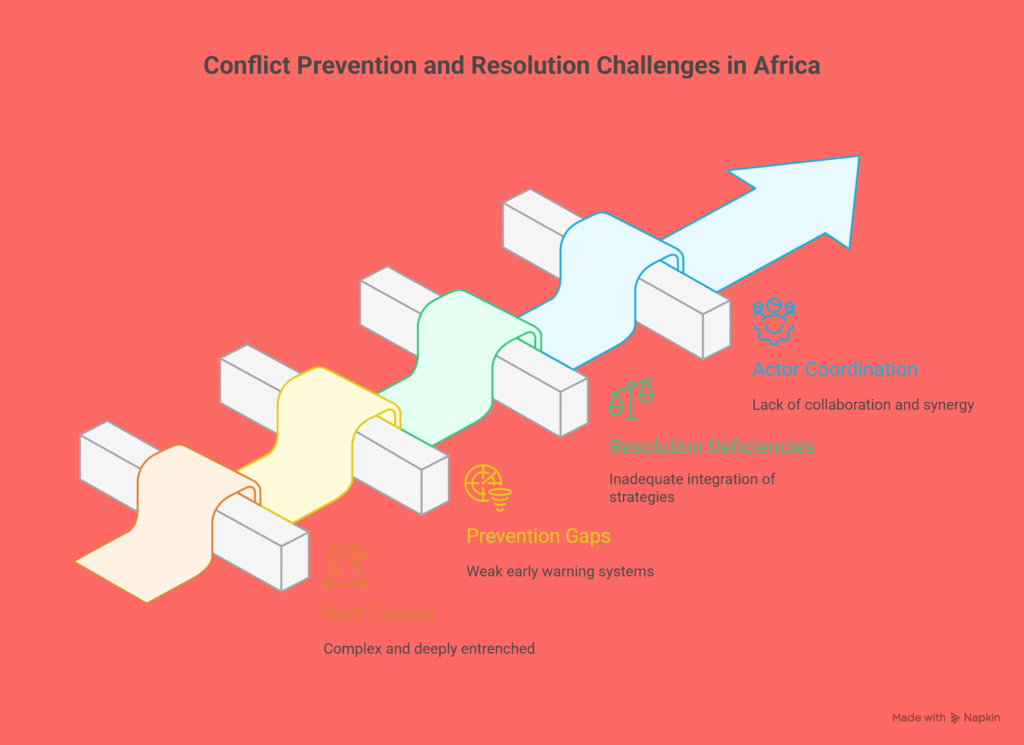
Challenges and Critiques
- Sovereignty and political will. States may resist external prevention measures; leaders often prioritize regime security over inclusive policies (de Waal, 2015).
- Capacity constraints. Limited administrative and financial resources impede sustained prevention (OECD, 2016).
- Coordination failures. Weak linkages among international, regional, national, and local actors undermine comprehensive responses (Autesserre, 2014).
- Overemphasis on short-term stabilization. Quick fixes without institutional reform increase relapse risk (Duffield, 2014).
- Perceptions of bias. International justice mechanisms may be perceived as targeting African actors disproportionately, undermining legitimacy (Akande, 2011).
Emerging Issues: Climate Change, Extremism, and Urbanization
Climate change intensifies competition over resources and displaces populations, creating new conflict dynamics (Benjaminsen & Ba, 2019). Violent extremism and transnational organized crime exploit governance vacuums and marginalization; countering them requires holistic approaches blending security, development, and rights protections (Mackinlay & Murphy, 2016). Rapid urbanization produces new conflicts over services and livelihoods, necessitating urban governance strategies integrated into prevention frameworks (Fay, 2011).
Best Practices and Policy Recommendations
- Strengthen early warning–early response linkages. Invest in data systems, analysis capacity, and rapid political instruments for preventive diplomacy. Ensure EWS outputs feed directly into decision-making bodies at national, regional, and international levels (Nilsson, 2012).
- Promote inclusive political processes. Support electoral integrity, decentralization, and mechanisms for minority representation to mitigate grievances. Design power-sharing carefully with sunset clauses and accountability measures (Reilly, 2001).
- Integrate security and development interventions. Combine SSR, DDR, and livelihoods programs to reduce incentives for violent mobilization. Align donor financing to multi-sectoral peacebuilding plans (Muggah & Sands, 2014).
- Empower local actors. Prioritize funding and technical support for community-driven peacebuilding, women-led initiatives, and traditional dispute resolution that complement formal institutions (Paffenholz, 2014).
- Enhance regional capacities. Invest in AU and REC operational readiness, logistics, and financing for rapid preventive deployments. Strengthen legal frameworks for cross-border cooperation (Murithi, 2009).
- Balance accountability and reconciliation. Design transitional justice in consultation with victims and communities to avoid re-traumatization and ensure legitimacy (Hayner, 2010).
- Address structural drivers. Long-term investments in education, employment, land tenure reform, and equitable resource governance reduce the structural causes of conflict (World Bank, 2011).
- Mainstream climate resilience into prevention. Integrate climate adaptation, water management, and agricultural extension services into prevention frameworks, particularly in pastoral and agro-pastoral zones (Benjaminsen & Ba, 2019).
Conclusion
Conflict prevention and resolution in Africa require multi-dimensional strategies tailored to local contexts, harmonizing formal institutions with indigenous mechanisms, and combining short-term stabilization with long-term structural reforms. Success depends on political will, credible institutions, sustained resources, and meaningful participation of local actors, particularly women and youth. Strengthening early warning–response capacities, promoting inclusive governance, investing in SSR and socio-economic development, and enhancing regional coordination are central to advancing sustainable peace. While challenges remain—capacity constraints, climate shocks, and evolving security threats—the continent’s rich experience with hybrid justice systems, community mediation, and innovative regional mechanisms provides a strong foundation for more effective prevention and resolution strategies.
References
- Adebanwi, W., & Obadare, E. (2010). When corruption fights back: Democracy and elite interest in Nigeria’s anti-corruption war. Journal of Contemporary African Studies, 28(1), 5–25.
- Akande, D. (2011). The International Criminal Court: challenges to achieving justice. International Affairs, 87(4), 825–839.
- African Union. (2013). The Common African Position on the Proposed UN Post-2015 Development Agenda (The AU Common Position). African Union Commission.
- African Union. (2014). Panel of the Wise: Issues Paper on Early Warning and Preventive Diplomacy. African Union Commission.
- Aning, K., & Atuobi, S. (2016). The African Union, regional organizations and peace operations in Africa. In C. T. Woods & S. R. Krauss (Eds.), Routledge Handbook of African Security (pp. 123–139). Routledge.
- Autesserre, S. (2014). Peaceland: Conflict Resolution and the Everyday Politics of International Intervention. Cambridge University Press.
- Ayoob, M. (1995). The Third World Security Predicament: State Making, Regional Conflict, and the International System. Lynne Rienner Publishers.
- Bannon, I., & Collier, P. (2003). Natural resources and violent conflict: Options and actions. The World Bank.
- Bates, R. H. (2008). When Things Fell Apart: State Failure in Late-Century Africa. Cambridge University Press.
- Bayart, J.-F., Ellis, S., & Hibou, B. (1999). The Criminalization of the State in Africa. Indiana University Press.
- Benjaminsen, T. A., & Ba, B. (2019). Why do pastoralists in Mali join jihadist groups? A political ecological perspective. In D. M. Larson & J. Springer (Eds.), Resources, Conflict, and Governance (pp. 45–68). Routledge.
- Berdal, M., & Zaum, D. (2013). Political Economy of Statebuilding: Power after Peace. Routledge.
- Blattman, C., & Miguel, E. (2010). Civil war. Journal of Economic Literature, 48(1), 3–57.
- Boutros-Ghali, B. (1992). An Agenda for Peace: Preventive diplomacy, peacemaking and peace-keeping. United Nations.
- Bryden, A., & Scherrer, V. (2012). Disarmament, demobilization and reintegration. In T. S. E. Orjuela & P. Vanhoonacker (Eds.), The Oxford Handbook of United Nations Peacekeeping Operations (pp. 1–29). Oxford University Press.
- Cawthra, G. (2006). Security sector reform in South Africa and the challenges of security governance. In R. E. Dalton & A. W. John (Eds.), Security Sector Reform in Africa (pp. 67–93). Geneva Centre for the Democratic Control of Armed Forces.
- Chabal, P., & Daloz, J.-P. (1999). Africa Works: Disorder as Political Instrument. International African Institute and James Currey.
- Clark, P. (2010). The Gacaca Courts, Post-Genocide Justice and Reconciliation in Rwanda: Justice without Lawyers. Cambridge University Press.
- Collier, P., & Hoeffler, A. (2004). Greed and grievance in civil war. Oxford Economic Papers, 56(4), 563–595.
- De Juan, A. (2009). Understanding African civil wars: Evidence and explanations. African Affairs, 108(431), 333–356.
- De Luca, G., & Cantore, N. (2018). Resource competition and conflict in Sub-Saharan Africa: Evidence and policy responses. Journal of African Economies, 27(4), 365–389.
- Des Forges, A. (1999). Leave None to Tell the Story: Genocide in Rwanda. Human Rights Watch.
- Diehl, P. F., & Druckman, D. (2014). The politics of negotiation and mediation in international conflicts. In P. F. Diehl (Ed.), The Oxford Handbook of International Security (pp. 355–378). Oxford University Press.
- Drumbl, M. A. (2007). Atrocity, Punishment and International Law. Cambridge University Press.
- Duffield, M. (2014). Global Governance and the New Wars: The Merging of Development and Security. Zed Books.
- Eck, K. (2009). The wrong story: Ethnic voting and ethnic conflict. Journal of Peace Research, 45(8), 955–965.
- Fortna, V. P. (2004). Does Peacekeeping Work? Shaping Belligerents’ Choices after Civil War. Princeton University Press.
- Fay, M. (2011). Rethinking infrastructure in a time of urbanization. World Bank Background Paper.
- Gberie, L. (2005). A Dirty War in West Africa: The RUF and the Destruction of Sierra Leone. Indiana University Press.
- Goodhand, J., & Hulme, D. (1999). From wars to complex political emergencies: Understanding conflict and peacebuilding in the new world disorder. Third World Quarterly, 20(1), 13–26.
- Hagmann, T., & Péclard, D. (2010). Negotiating statehood: Dynamics of power and domination in Africa. Development and Change, 41(4), 539–562.
- Hayner, P. B. (2010). Unspeakable Truths: Transitional Justice and the Challenge of Truth Commissions (2nd ed.). Routledge.
- Kagwanja, P., & Southall, R. (2009). Kenya’s uncertain democracy: The electoral crisis of 2007–2008 and its aftermath. Journal of Contemporary African Studies, 27(3), 235–253.
- Kalyvas, S. N. (2006). The Logic of Violence in Civil War. Cambridge University Press.
- Keen, D. (2005). Conflict and Collusion in Sierra Leone. James Currey.
- Kieh, G. K. (2008). Liberia: The military and post-conflict reconstruction. African Security Review, 17(3), 42–56.
- Knight, M., & Ozerdem, A. (2004). Guns, camps and cash: Disarmament, demobilization and reinsertion of former combatants in transitions from war to peace. Journal of Peace Research, 41(4), 499–516.
- Longman, T. (2017). Memory and Justice in Post-Genocide Rwanda. Cambridge University Press.
- Lund, C. (2006). Twilight institutions: Public authority and local politics in Africa. Development and Change, 37(4), 685–705.
- Mackinlay, J., & Murphy, M. (2016). Arms and conflict in Africa. In J. Cooke & B. O’Halloran (Eds.), Contemporary Conflict and Development (pp. 89–108). Routledge.
- Møller, J., & Sviridenko, D. (2016). Violence and conflict in Africa: A review of current trends. African Security Review, 25(2), 1–20.
- Muggah, R. (2013). Security and post-conflict reconstruction. In World Development Report 2011: Conflict, Security, and Development. World Bank.
- Adebanwi, W., & Obadare, E. (2010). When corruption fights back: Democracy and elite interest in Nigeria’s anti-corruption war. Journal of Contemporary African Studies, 28(1), 5–25. https://doi.org/10.1080/02589000903542585
- Akande, D. (2011). The International Criminal Court: Challenges to achieving justice. International Affairs, 87(4), 825–839. https://doi.org/10.1111/j.1468-2346.2011.01006.x
- African Union. (2013). The common African position on the proposed UN post-2015 development agenda (The AU common position). African Union Commission.
- African Union. (2014). Panel of the Wise: Issues paper on early warning and preventive diplomacy. African Union Commission.
- Aning, K., & Atuobi, S. (2016). The African Union, regional organizations and peace operations in Africa. In C. T. Woods & S. R. Krauss (Eds.), Routledge handbook of African security (pp. 123–139). Routledge.
- Autesserre, S. (2014). Peaceland: Conflict resolution and the everyday politics of international intervention. Cambridge University Press.
- Ayoob, M. (1995). The third world security predicament: State making, regional conflict, and the international system. Lynne Rienner Publishers.
- Bannon, I., & Collier, P. (2003). Natural resources and violent conflict: Options and actions. The World Bank.
- Bates, R. H. (2008). When things fell apart: State failure in late-century Africa. Cambridge University Press.
- Bayart, J.-F., Ellis, S., & Hibou, B. (1999). The criminalization of the state in Africa. Indiana University Press.
- Benjaminsen, T. A., & Ba, B. (2019). Why do pastoralists in Mali join jihadist groups? A political ecological perspective. In D. M. Larson & J. Springer (Eds.), Resources, conflict, and governance (pp. 45–68). Routledge.
- Berdal, M., & Zaum, D. (2013). Political economy of statebuilding: Power after peace. Routledge.
- Blattman, C., & Miguel, E. (2010). Civil war. Journal of Economic Literature, 48(1), 3–57. https://doi.org/10.1257/jel.48.1.3
- Boutros-Ghali, B. (1992). An agenda for peace: Preventive diplomacy, peacemaking and peace-keeping. United Nations.
- Bryden, A., & Scherrer, V. (2012). Disarmament, demobilization and reintegration. In T. S. E. Orjuela & P. Vanhoonacker (Eds.), The Oxford handbook of United Nations peacekeeping operations (pp. 1–29). Oxford University Press.
- Cawthra, G. (2006). Security sector reform in South Africa and the challenges of security governance. In R. E. Dalton & A. W. John (Eds.), Security sector reform in Africa (pp. 67–93). Geneva Centre for the Democratic Control of Armed Forces.
- Chabal, P., & Daloz, J.-P. (1999). Africa works: Disorder as political instrument. International African Institute & James Currey.
- Clark, P. (2010). The Gacaca courts, post-genocide justice and reconciliation in Rwanda: Justice without lawyers. Cambridge University Press.
- Collier, P., & Hoeffler, A. (2004). Greed and grievance in civil war. Oxford Economic Papers, 56(4), 563–595. https://doi.org/10.1093/oep/gpf064
- De Juan, A. (2009). Understanding African civil wars: Evidence and explanations. African Affairs, 108(431), 333–356. https://doi.org/10.1093/afraf/adp017
- De Luca, G., & Cantore, N. (2018). Resource competition and conflict in Sub-Saharan Africa: Evidence and policy responses. Journal of African Economies, 27(4), 365–389. https://doi.org/10.1093/jae/ejy009
- Des Forges, A. (1999). Leave none to tell the story: Genocide in Rwanda. Human Rights Watch.
- Diehl, P. F., & Druckman, D. (2014). The politics of negotiation and mediation in international conflicts. In P. F. Diehl (Ed.), The Oxford handbook of international security (pp. 355–378). Oxford University Press.
- Drumbl, M. A. (2007). Atrocity, punishment and international law. Cambridge University Press.
- Duffield, M. (2014). Global governance and the new wars: The merging of development and security. Zed Books.
- Eck, K. (2009). The wrong story: Ethnic voting and ethnic conflict. Journal of Peace Research, 45(8), 955–965. https://doi.org/10.1177/0022343308096157
- Fortna, V. P. (2004). Does peacekeeping work? Shaping belligerents’ choices after civil war. Princeton University Press.
- Fay, M. (2011). Rethinking infrastructure in a time of urbanization. World Bank Background Paper.
- Gberie, L. (2005). A dirty war in West Africa: The RUF and the destruction of Sierra Leone. Indiana University Press.
- Goodhand, J., & Hulme, D. (1999). From wars to complex political emergencies: Understanding conflict and peacebuilding in the new world disorder. Third World Quarterly, 20(1), 13–26. https://doi.org/10.1080/01436599914076
- Hagmann, T., & Péclard, D. (2010). Negotiating statehood: Dynamics of power and domination in Africa. Development and Change, 41(4), 539–562. https://doi.org/10.1111/j.1467-7660.2010.01646.x
- Hayner, P. B. (2010). Unspeakable truths: Transitional justice and the challenge of truth commissions (2nd ed.). Routledge.
- Kagwanja, P., & Southall, R. (2009). Kenya’s uncertain democracy: The electoral crisis of 2007–2008 and its aftermath. Journal of Contemporary African Studies, 27(3), 235–253. https://doi.org/10.1080/02589000903154892
- Kalyvas, S. N. (2006). The logic of violence in civil war. Cambridge University Press.
- Keen, D. (2005). Conflict and collusion in Sierra Leone. James Currey.
- Kieh, G. K. (2008). Liberia: The military and post-conflict reconstruction. African Security Review, 17(3), 42–56. https://doi.org/10.1080/10246029.2008.9627483
- Knight, M., & Ozerdem, A. (2004). Guns, camps and cash: Disarmament, demobilization and reinsertion of former combatants in transitions from war to peace. Journal of Peace Research, 41(4), 499–516. https://doi.org/10.1177/0022343304044479
- Longman, T. (2017). Memory and justice in post-genocide Rwanda. Cambridge University Press.
- Lund, C. (2006). Twilight institutions: Public authority and local politics in Africa. Development and Change, 37(4), 685–705. https://doi.org/10.1111/j.1467-7660.2006.00497.x
- Mackinlay, J., & Murphy, M. (2016). Arms and conflict in Africa. In J. Cooke & B. O’Halloran (Eds.), Contemporary conflict and development (pp. 89–108). Routledge.
- Møller, J., & Sviridenko, D. (2016). Violence and conflict in Africa: A review of current trends. African Security Review, 25(2), 1–20. https://doi.org/10.1080/10246029.2016.1169478
- Muggah, R. (2013). Security and post-conflict reconstruction. In World development report 2011: Conflict, security, and development. World Bank.
- Muggah, R., & McDonald, S. (2018). Post-conflict stabilization and peacebuilding. In J. Goodhand et al. (Eds.), Peacebuilding in conflict-affected contexts (pp. 23–48). Palgrave Macmillan.
- Muggah, R., & Sands, M. (2014). The SDGs and peace: How must conflict-affected states be accounted for in the 2030 Agenda? Stability: International Journal of Security and Development, 3(1), 1–16. https://doi.org/10.5334/sta.df
- Murithi, T. (2009). The African Union’s role in peace support operations. International Peacekeeping, 16(4), 546–556. https://doi.org/10.1080/13533310903139860
- Nilsson, D. (2012). Anchoring the peace: Civil society actors in peace agreements and durable peace. International Negotiation, 17(2), 329–356. https://doi.org/10.1163/157180612X634219
- North, D. C. (1990). Institutions, institutional change and economic performance. Cambridge University Press.
- Organisation for Economic Co-operation and Development (OECD). (2016). States of fragility 2016. OECD Publishing. https://doi.org/10.1787/9789264267213-en
- Paffenholz, T. (2014). International peacebuilding goes local: Analysing Lederach’s conflict transformation theory and its ambiguous encounter with 20 years of practice. Peacebuilding, 2(1), 11–27. https://doi.org/10.1080/21647259.2013.876449
- Reno, W. (2011). Warfare in independent Africa. Cambridge University Press.
- Reilly, B. (2001). Democracy in divided societies: Electoral engineering for conflict management. Cambridge University Press.
- Roeder, P. G., & Rothchild, D. (2005). Sustainable peace: Power and democracy after civil wars. Cornell University Press.
- Rothchild, D., & Perlmutter, A. (2009). Africa’s gains and losses. In J. Campbell & H. Flynn (Eds.), The new security agenda (pp. 101–124). Palgrave Macmillan.
- Sedra, M. (2010). Security sector reform in Afghanistan: The slide towards expediency. International Peace Institute.
- Sriram, C. L. (2014). Africa: Should the UN Security Council be more active on prevention? In P. Wallensteen (Ed.), Preventing violent conflicts: Past failure, future challenges. Routledge.
- Stewart, F. (2010). Horizontal inequalities and conflict: An introduction and some policy implications. In D. H. de Janvry & E. Sadoulet (Eds.), Poverty, inequality, and development (pp. 88–114). Routledge.
- United Nations. (1992). An agenda for peace: Preventive diplomacy, peacemaking and peace-keeping. United Nations.
- United Nations. (2009). Report of the Secretary-General on peacebuilding in the immediate aftermath of conflict. UN Security Council.
- UN Women. (2015). Preventing conflict and mediating peace: A guide for gender-sensitive mediation. United Nations Entity for Gender Equality and the Empowerment of Women.
- Williams, P. D. (2012). From non-intervention to non-indifference: The origins and development of the African Union’s security culture. African Affairs, 111(443), 253–279. https://doi.org/10.1093/afraf/ads019
- Williams, P. D. (2014). Fighting for peace in Somalia: A history and analysis of the African Union Mission (AMISOM), 2007–2014. Oxford University Press.
- World Bank. (2011). World development report 2011: Conflict, security, and development. World Bank.
Note on sources and further reading
This article synthesized scholarly literature, institutional reports, and case studies widely used in peace and conflict studies. For deeper inquiry, the reader should consult the core works listed above and institution-specific materials from the AU, UN DPA, ECOWAS, IGAD, and leading think tanks (e.g., International Crisis Group, ISS, Chatham House).